


from collective exploration with fellow artists and researchers Malu Lopez and Lama Hasan on solar embodiment during research residency with AADK Spain. Videographer Hamish Logan
The body, in this cosmology, becomes an elemental actor—a sensate vessel inscribed by light, charged by invisible fields, attuned to mineral memory and solar rhythm. No longer bounded by skin, the body operates as a solar sensorium, absorbing, responding, and dissolving into a choreography of electromagnetic forces. Here, human agency entangles with planetary and stellar materialities, dispersing into a field of radiant co-creation.
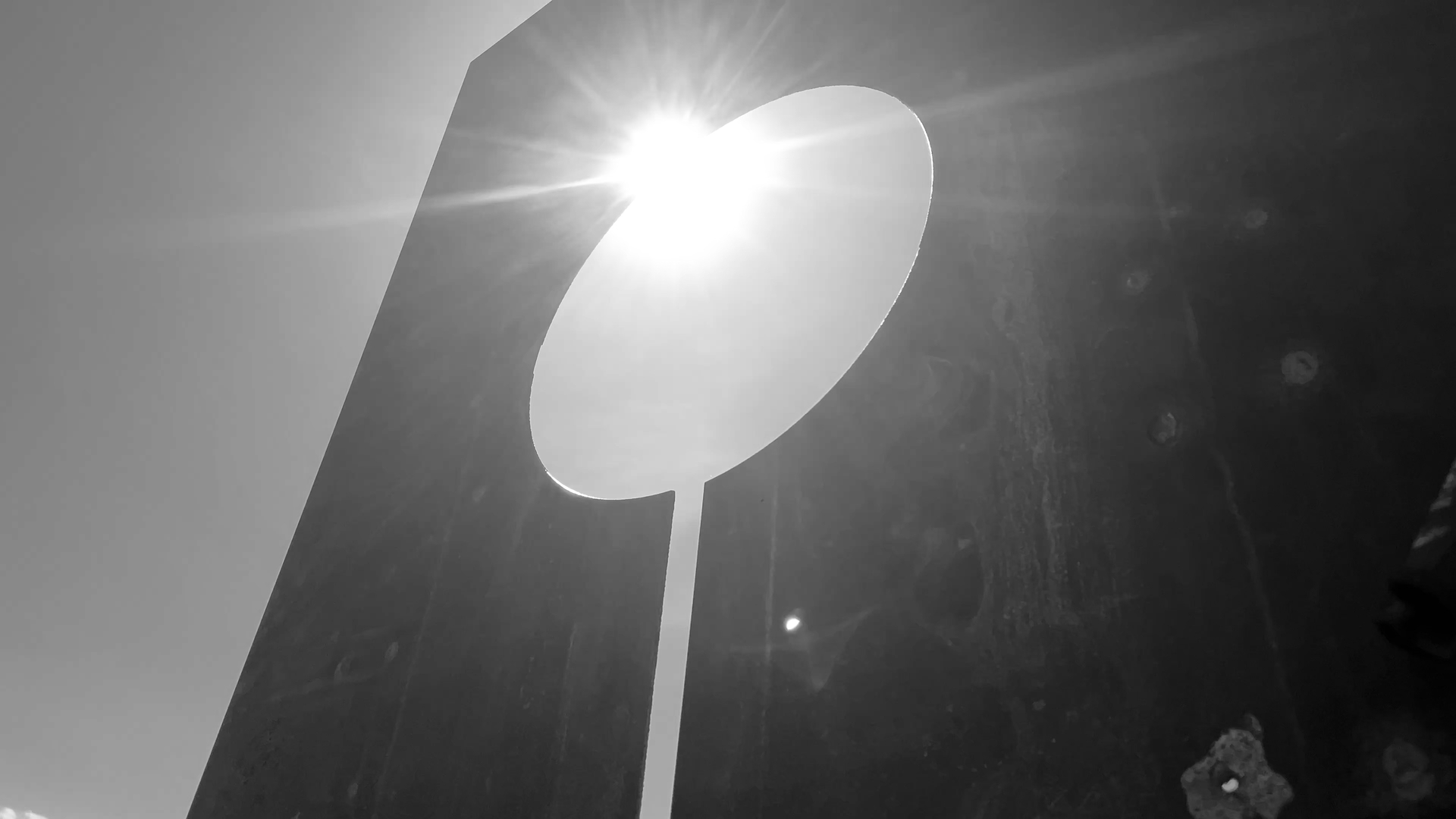
from the sculpture "sun portal", a 3 piece resonance metal sculpture on hum-sun-earth entanglement. videographer: Ehsan
Sunlight carries the paradox of absence and presence - forming a shape. Salt as one shape of solar presence and water absence :emerges as the crystallized residue of this entanglement—a mineral formed through the withdrawal of water, shaped by the slow force of the sun: the still archive of ancient seas, and the trace of light made tangible. Salt, like the body, is a vessel of memory—capable of holding both dissolution and continuity.
Filmed in deserts and salinas, the work navigates the meeting points of evaporation and emergence, where solar bodies—human and more-than-human—become instruments of transformation. Influenced by Octavia E. Butler’s Earthseed and its invocation—God is Change, the first chapter of Staring at the sun in times of darkness—the project treats change not as rupture but as rhythm, not as loss but as form.

Julia Flux during her first movement exploration with the earth sculptural element of "God is change" Chapter I of Staring at the Sun in times of darkness. videographer: Ehsan
To stare at the Sun is to face the unseeable: a radical intimacy with that which shapes us but cannot be held. The work invites a return—not nostalgic but elemental—to the source of all motion, asking how we might reimagine divinity through photons, minerals, and the precise violence of light. Where migration becomes birthright.
Absence is a form.
On Solar Bodies: movement and dance as activism and belonging
To move is to be in flux, continually reshaped by forces both visible and imperceptible. We exist within planetary cycles—solar radiation, shifting electromagnetic fields, the slow weathering of stone, the migration of dust. Movement is not merely response; it is a practice of adaptation, sensing, and aligning with change as it unfolds.
In the Julia FLux works like TERRA and Pouring Sand into the time machine, the human body is understood as a vessel—holding, transmitting, eroding, and reforming. These works explore how bodies, like landscapes, absorb and translate surrounding forces. Desertification, akin to the transformations of the body, is not an endpoint, but a continuous, dynamic process. The act of pouring sand, for example, echoes the slow rhythm of erosion and renewal, a tactile meditation on time and the invisible forces at play.
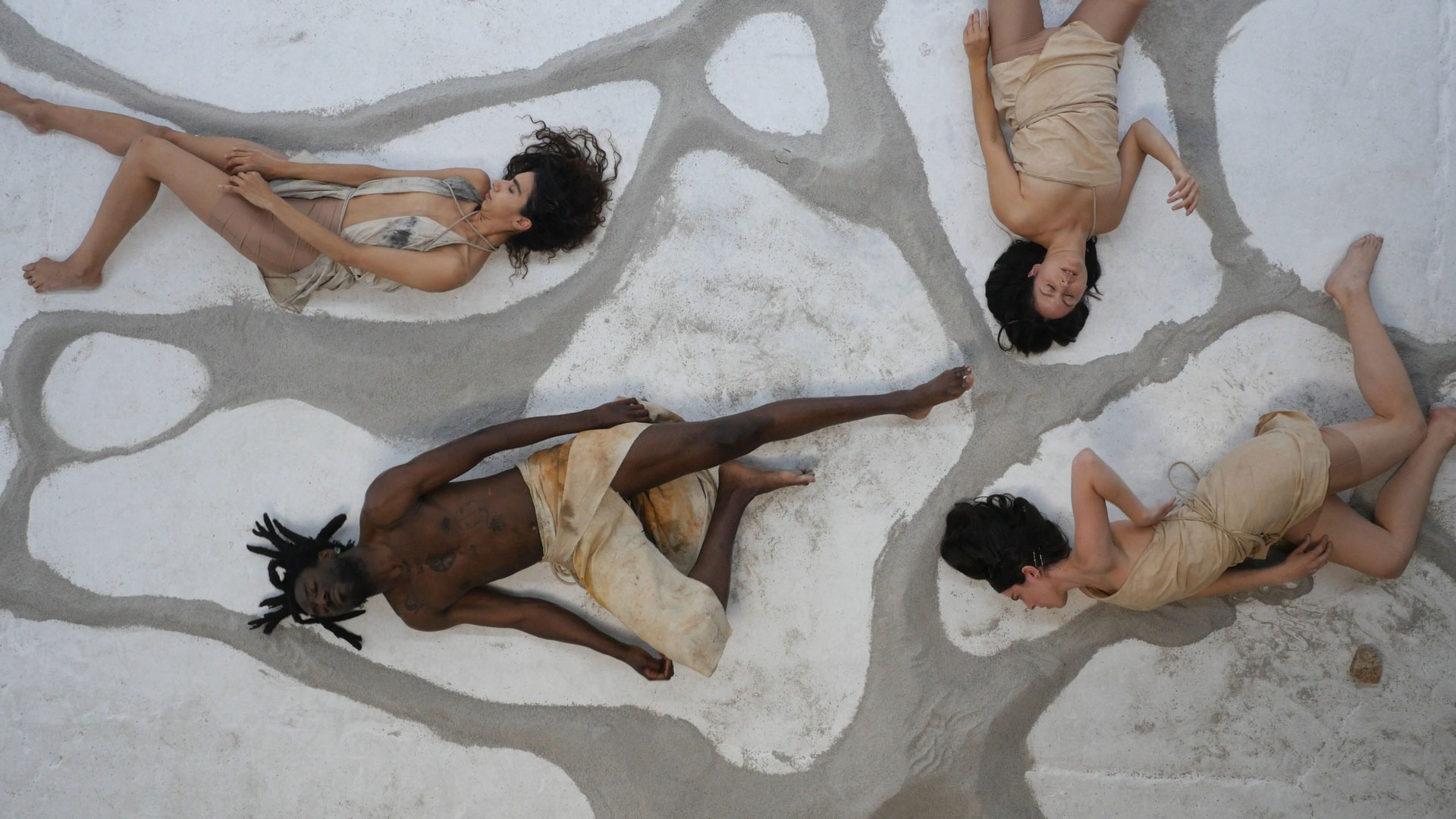
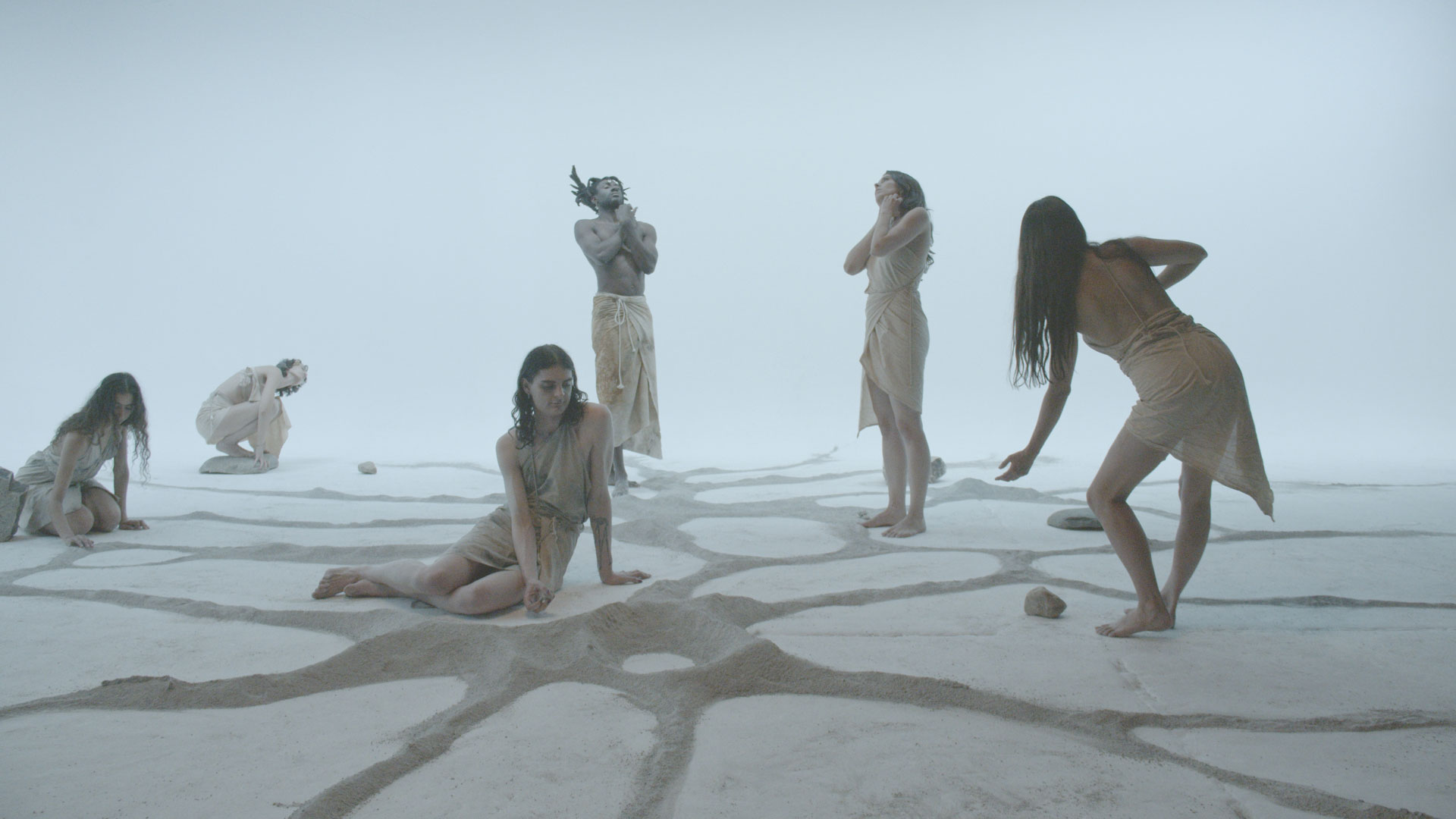
But what if the body could move not only in response to the environment but as a way to actively engage with it? How might we, like migratory animals that rely on geomagnetic forces to navigate, use the human body—through movement—as a tool for resilience and orientation in a shifting world?
The electromagnetic fields of the Earth, though invisible, subtly shape our perception, cognition, and spatial awareness. These fields influence animal migration, guiding their journey across vast distances. Could the human body, similarly, be a receiver and transmitter of these forces, a vessel tuned to navigate the forces shaping our futures?
In Julia Flux works, the body becomes sculpture, medium and a method for sensing these shifts. Pouring sand into the time machine considers how the body holds and translates energies—solar, electromagnetic, geomagnetic—as both container and transmitter. These forces ripple through us, subtly affecting our emotional and physical states, recalibrating us in ways both subtle and profound. Dance, in this context, becomes a practice of resilience—a method of navigating these forces, learning to adapt through motion.
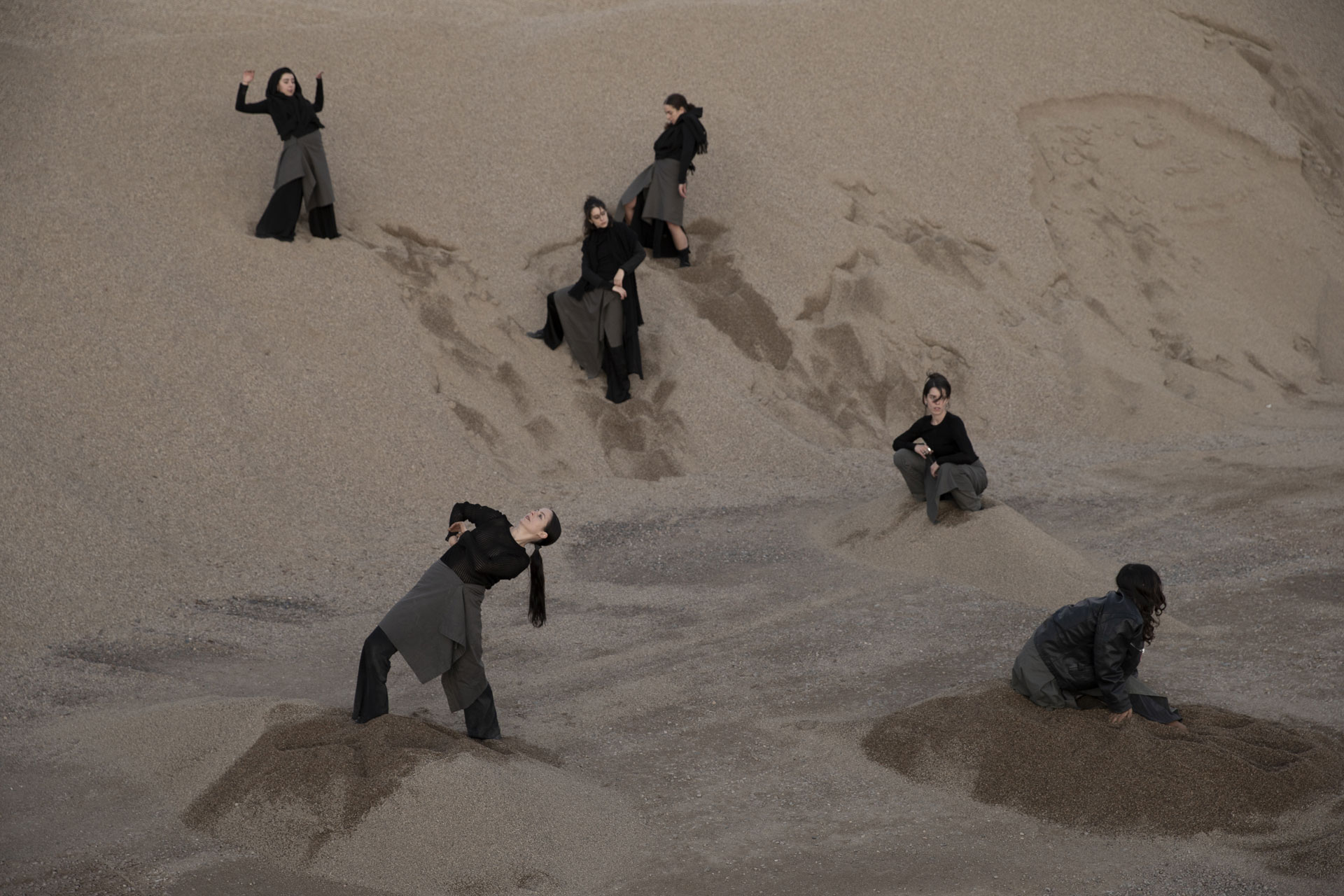
taken during the performance "Pouring Sand into the Time Machine". Rodian Gill
In her sculptural dance installations, where sculpture and movement meet, she choreographs resilience through interaction with these natural and cosmic rhythms.She explores how the body responds to the invisible forces of the Earth and Sun. Here, movement is not just an expression; it is a form of communication with the environment, a way to tune into the subtle shifts of the world around us. The sculptural elements of these installations create spaces that invite the body to recalibrate, aligning with the ever-changing forces of the Earth.
In a time of environmental and societal flux, dance becomes a tool for staying present in transition, for working with instability rather than resisting it. Through movement, we learn that adaptation is not a passive state, but an active engagement with the world’s rhythms. The body is not merely reacting; it is navigating the currents of change, embodying resilience in the process.
To move is to recognize that nothing is static. Identity, like matter, is fluid—shaped by contact, pressure, and release. Resilience is about shifting with the currents, existing within motion. Transition is not an interruption, but the very condition of existence itself.
About the author (Visit Habitat Profile)
At the intersection of performance, dance, environmental science and spiritual ecology, Flux’s artistic work is deeply informed by ancient knowledge and speculative futures - exploring the interconnectedness as well as the frictions between humans and nature.
To weave connections of these space-time-matters she works often in remote locations -such as deserts and mining sites - where she reveals and actively transforms underlying myths with the aim for collective,trans-planetary healing and health. Re-imaginaging and re-enchanting desirable ecological, sonic, bodily and more-than-human futures.
Flux’s work challenges the blurred lines between human, natural forces and technology, critically reflecting on growth and evolution paradigms. In her central work as a dancer and ecologist, her practice spans fictionfilm, landart, installations and performance, often incorporating experimental sculptural elements. By combining natural elements with industrial materials, she creates raw, yet fictional scenarios which are recalling us back into sensual communities of practice in reciprocity with the land while sheding light onto processes of industrialization, commodification and desertification. Her work is a form of commoning within science and art, breaking down disciplinary boundaries and fostering a collective re-enchantment with the world.
Central to her recent research is the human-sun relationship, exploring how solar forces shape bodily perception, communication, and myth-making. As both a life-giving and disruptive force, the Sun governs biological rhythms and climate cycles while coronal mass ejections (CMEs) threaten global communication and energy systems. Drawing from feminist sci-fi writers like Octavia Butler, Julia examines how solar activity influences not just survival but also future societies, cultural narratives, and embodied knowledge.
Flux collaborates with scientists, ecologists, and other artists to create media that are questioning the cultural conditioning of our senses and perceptions, constantly highlighting the body and nature as a vessel for transformational processes. Her installations and performances activate vivid and raw fictional scenarios that provoke incisive questions about the human,culture and world building; exampled in her recent work TERRA/// - a landart dance and movement performance piece which embraces the concept of an animated and vibrant world where every form of matter is alive and is therefore a broader feminist and ecological effort to reclaim the means of reproduction—material, spiritual, and communal—for a life-centric future.
She is the founder of MOJOSTUDIOS, an inclusive gallery that empowers marginalized voices, and the creator of CADAVRE EXQUIS, a project and exhibition series that tackles social- ecological justice and spiritual ecology. Her work also delves into post-natural, queer, and spiritual ecologies, alchemy, and mythology, with the aim of rewilding our collective myths and expanding our understanding of spacetime and community. Dedicated to reimagine a more-than-human peaceful trans-planetary co-existance she co-created the art project CURRENT FUTURES in collaboration with the marine NGO Montemero, highlighting the deserts of the worlds and their extremity as laboratories for testing these desirable ancient futures.
Challeging the growth-paradigma she questioned the status quo in her co-authorship in the book "Economy without Growth?!", accomplished her Degree in the Dance Intense Program of the Berlin Dance Institute 2022, exhibited during CTM Berlin in Funkhaus Berlin and researched on desertification processes, electromagnetism and nomadic lifeforms in the Naqab/hebrew Negev Desert, and in the Atacama desert of Chile.