
The 18th Science New Wave Festival to be held Oct. 17-19, 2025 brings together dozens of indie short and feature-length films that are connected to science and scientists, real or fictional. One of its upcoming programs draws on the evocative idea of metamorphosis, a radical transformation in the shape or properties of an animal, person, or thing; for instance, in biology, a caterpillar becoming a butterfly. The term can also represent magical, divine, or mythical change, as in Metamorphoses by the Roman poet Ovid (8th century CE); and symbolic or metaphorical change, as when Gregor Samsa awakens to find he has become a giant cockroach in Franz Kafka’s The Metamorphosis (1915). Further meanings show up in the Festival’s short films assembled under the title “Metamorphoses.”
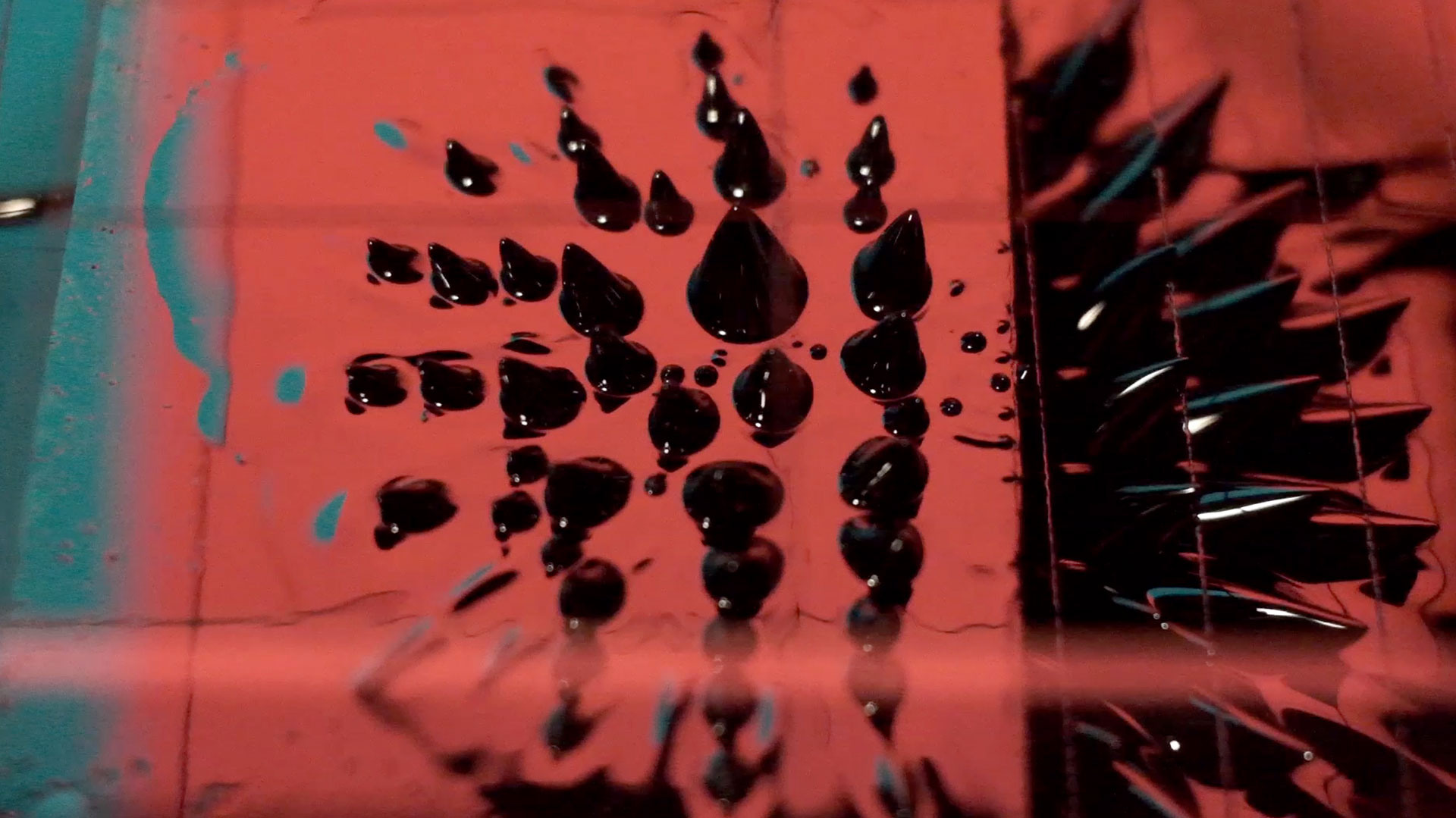
A Seed is Planted (director, Gregor Eldarb, 2024, 10 min) is a continually changing abstract display. Against various backgrounds, we see simple or intricate rounded, rectangular and linear forms mingling, sometimes merging, with streams and crowds of small dense droplets; ripples like those surrounding a stone flung into a pond; shapes opening like flowers; and more, all in slow movement that produces constantly evolving shapes. A voice-over tells us: “Liquid crystal is a morphing form. It freezes. It flows. It has always been here. It appears anew.”
The film is about liquid crystals, a form of matter with molecules that are more ordered than their semi-random state in a true liquid, yet less ordered than the locked-in atoms or molecules of a solid crystal like salt. Liquid crystal molecules tend to be aligned but can change orientation under an electric voltage and other stimuli, making the material useful in display technology and other applications. The ongoing voice-over touches on these points, but it is citing excerpts from the book Liquid Crystals: The Science and Art of a Fluid Form (2016) by Esther Leslie, which is largely devoted to the metaphorical and artistic significance of liquid crystals. Watch and listen to the film and you’ll get a sense of the mysteries and paradoxes within this malleable state of matter.
A Seed is Planted (director, Gregor Eldarb, 2024, 10 min)
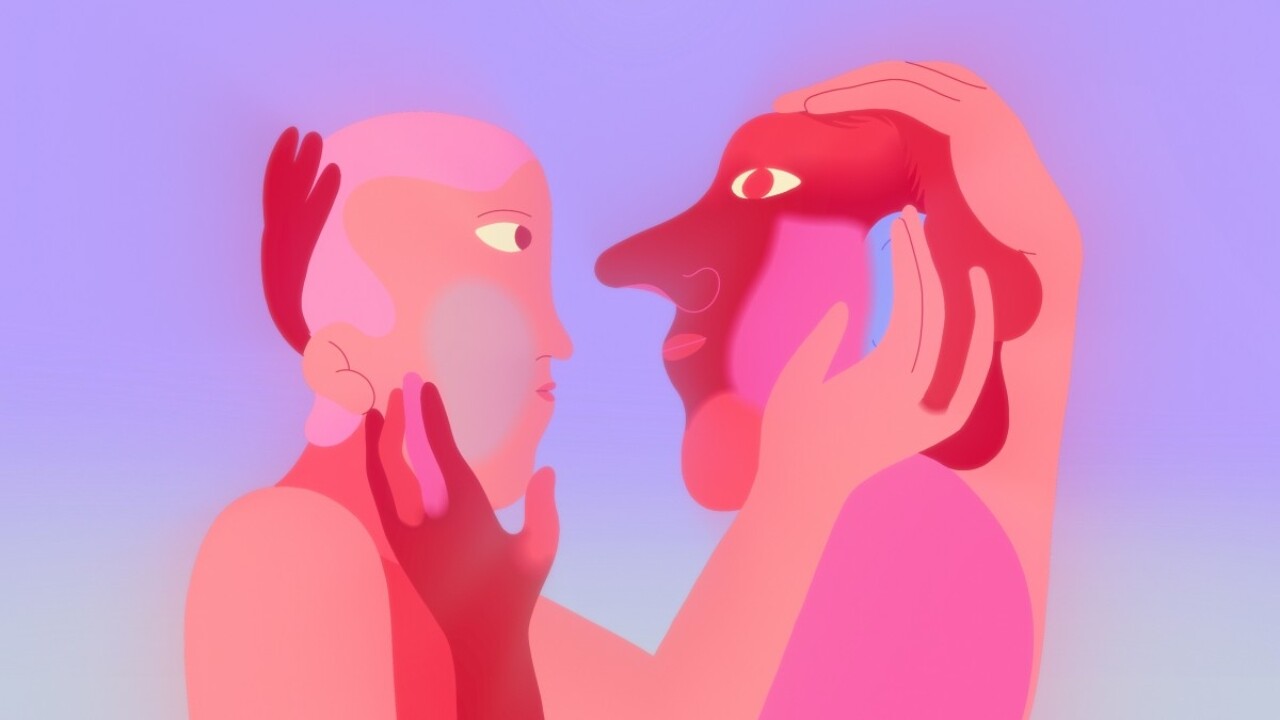
The poet e. e. cummings once wrote “i carry your heart with me…i am never without it.” The animated film Wish You Were Ear ( director/writer Mirjana Balogh, 2025, 10 min) turns this romantic image, where lovers are transformed by becoming part of each other, into ironic reality. In a future world, we see a couple depicted in dark tones of blue and violet that indicate their unhappiness: their relationship is ending. In this society, such an ending is marked by a ritual where advanced medical devices remove, exchange, and reattach the couple’s left ears so each person carries a bit of the other as a visible sign of their romantic failure.
The more forlorn of the lovers takes this shame and disfigurement badly, and becomes further depressed when viewing vestiges of his other failed relationships. But as he begins to reflect inwardly and find the strength to again turn outward, he encounters a woman whose left ear is his own former one. This symbol of his earlier self encourages him to approach her and start a new relationship. Without a word of dialogue, the film is a strong metaphor for the life cycle of romantic connections and how they invariably change us.
Wish You Were Ear ( director/writer Mirjana Balogh, 2025, 10 min)
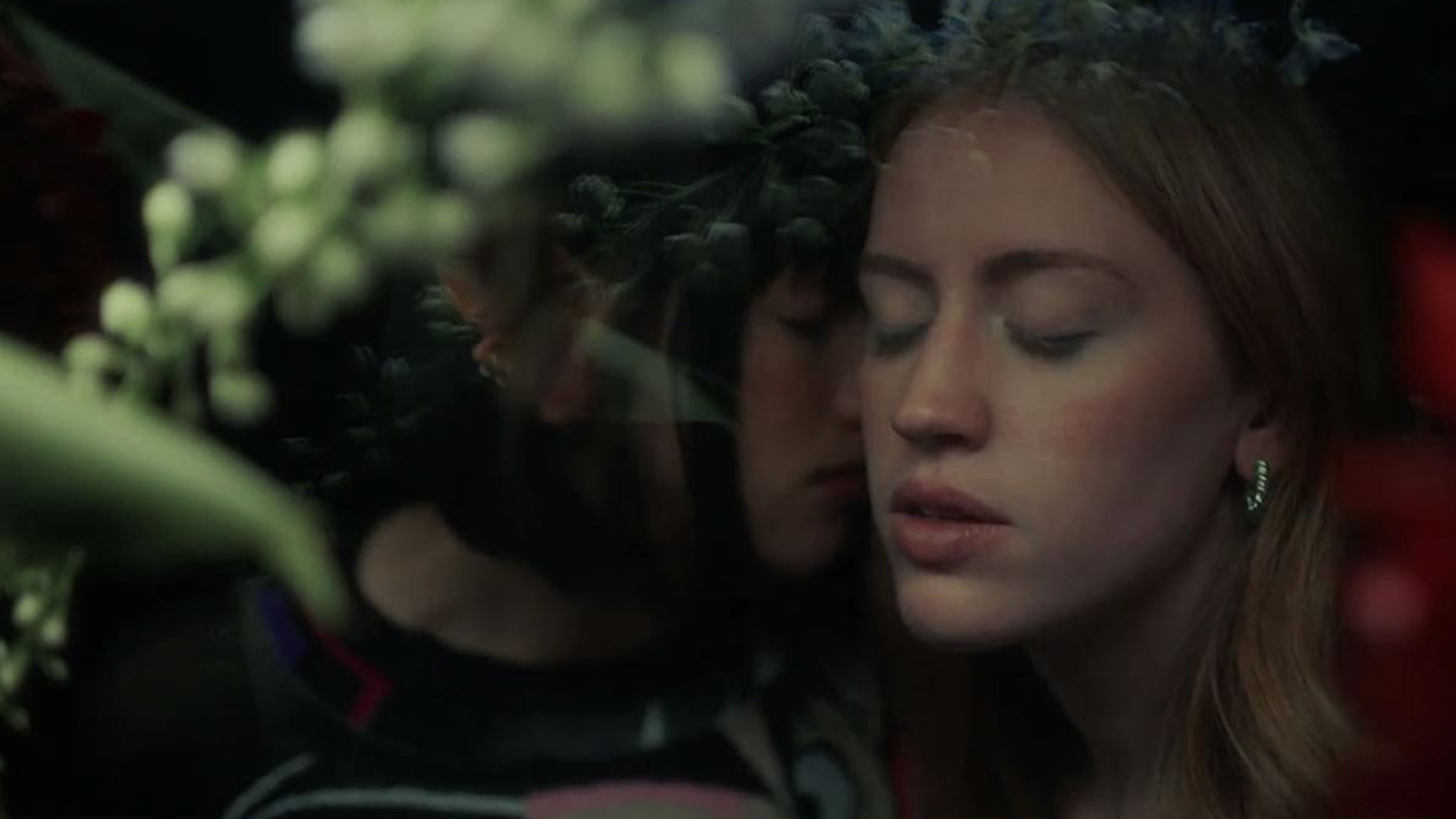
The Mexican film La era de las plantas con flor (The Age of Flowering Plants) (director, Magaly Ugarte de Pablo, 2025, 18 min) uses butterflies, who appear in ancient Mexican lore, as an image of human transformation. The film opens with a slowly pulsing cluster of biological cells. Then we see lush flowers and plants in a flower shop with Valeria, the shop salesperson, working among them. Two women enter and admire an orchid. One tells the other, “It looks like your vulva,” and they kiss and nuzzle. Valeria watches, then turns away; but later it’s clear that their public display of sex and affection has excited her. We next see Valeria, with butterfly earrings, watching a woman sing before an audience. The performer’s ears are very large, wing-like with pointed tips, and are definitely real according to Valeria’s friend.
Valeria is learning that the world contains sex and people that differ from and perhaps offer more than what she has known. The strands come together when a woman with wing-like ears takes Valeria to visit the butterfly house, and seduces her into her first-time sex with a woman. Valeria is upset when the woman ghosts her and also as she sees her own body begin to change. Two crescent-shaped marks appear on her back and her ears become pointed. Underlining the change, an interlude shows the biological cells becoming more fully developed. In the final scene, Valeria stands on a high roof-top deck, the wind blowing her hair. With a sudden movement and a whirr of sound, large butterfly-like wings unfold from her back. As Valeria faces her new inscrutable future as a metamorphosed woman, the camera slowly pulls away in a long shot until we can longer see her against the cityscape.
La era de las plantas con flor (The Age of Flowering Plants) (director, Magaly Ugarte de Pablo, 2025, 18 min)
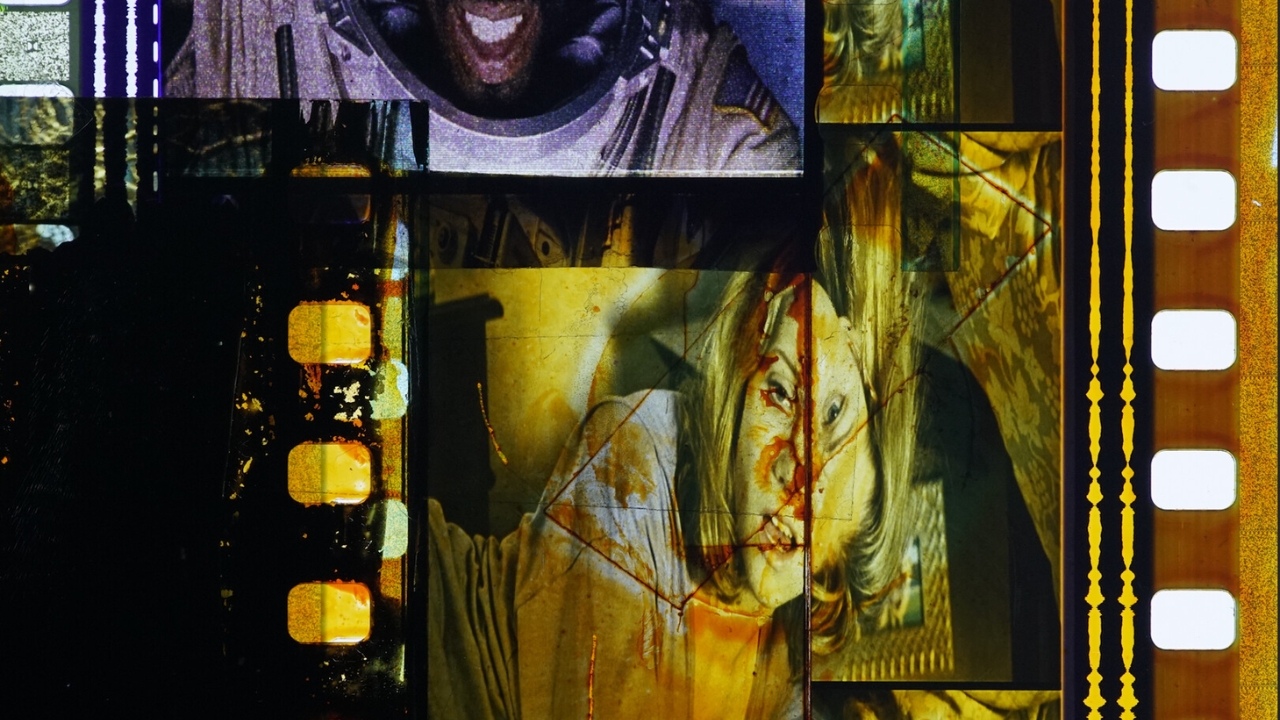
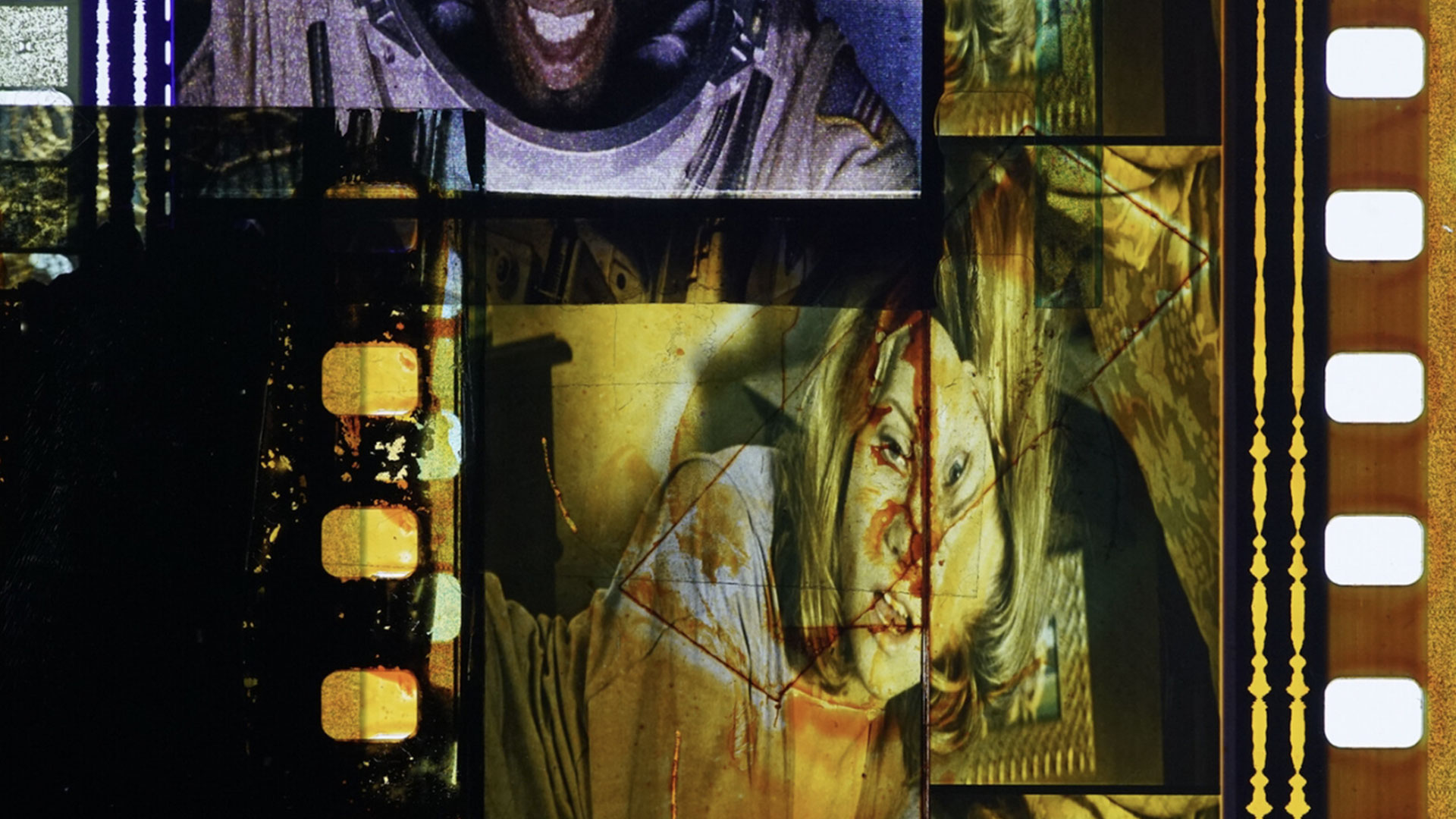
In Kaleidosprocket (director, Tim Grabham, 2025, 8 mins), the filmmaker combines the whirlwind formation of patterns you see through an old-fashioned kaleidoscope as you rotate it, with classic movie technology where toothed gears – sprockets – carry perforated reels of film past a light source and lens to be projected on a screen. Today most movies are shot and distributed digitally; but some studio directors, and many art film and experimental filmmakers, still prefer working in analog form with real film stock.
Kaleidosprocket displays actual film strips, complete with their sprocket holes and audio tracks that are visually recorded along the edge of the strip. The final credits tell us that these are 35 mm trailers chosen from a dozen sources including movies from Black Moon Rising (1986) through Mission to Mars (2004) to I’ve Loved You So Long (2008). They’re shown rapid-fire and in every possible way and combination: individual frames and entire strips; in motion and as stills; separately and together; and horizontally, vertically (sometimes upside down), or at an angle. Accompanied by a scintillating sound track, the result is a screen full of varied and engaging activity and images, with the added interest of trying to identify the films (I didn’t get any of them).
The old clips remain visually the same as they once were, but there is a kind of metamorphosis in displaying them in a mixed and evolving format. Also the old film technology reminds us that when film originated in the late 19th century, viewers were amazed at its ability to capture motion. Film was the first medium to show change and metamorphosis in real time.
Kaleidosprocket (director, Tim Grabham, 2025, 8 mins)
explant/implant (director, Josh Weissbach, 2025, 3 min) begins with a rapid flicker of shots showing a cinematographer behind a handheld camera, part of a man’s chest with a barely visible healed scar, and scenes of driving fast along roads and city streets to a hospital. A voice asks “Who’s the patient?” The answer “Me, Josh Weissbach,” tells us that this is Weissbach’s own story. He is having his sixteen year-old heart pacemaker replaced at age 38 as part of a “lifetime of surgeries,” according to the film’s tagline. The film continues with a fast montage of the hospital experience – Weissbach’s ID bracelet, medical equipment and personnel, a hospital bed, other patients – and an audio overlay of hospital sounds and not always intelligible voices. At the end, Weissbach is rolled out on a wheelchair, then we see his own metamorphosis: a new scar overlaying the old one, the sign of his new lifesaving device.
explant/implant (director, Josh Weissbach, 2025, 3 min)
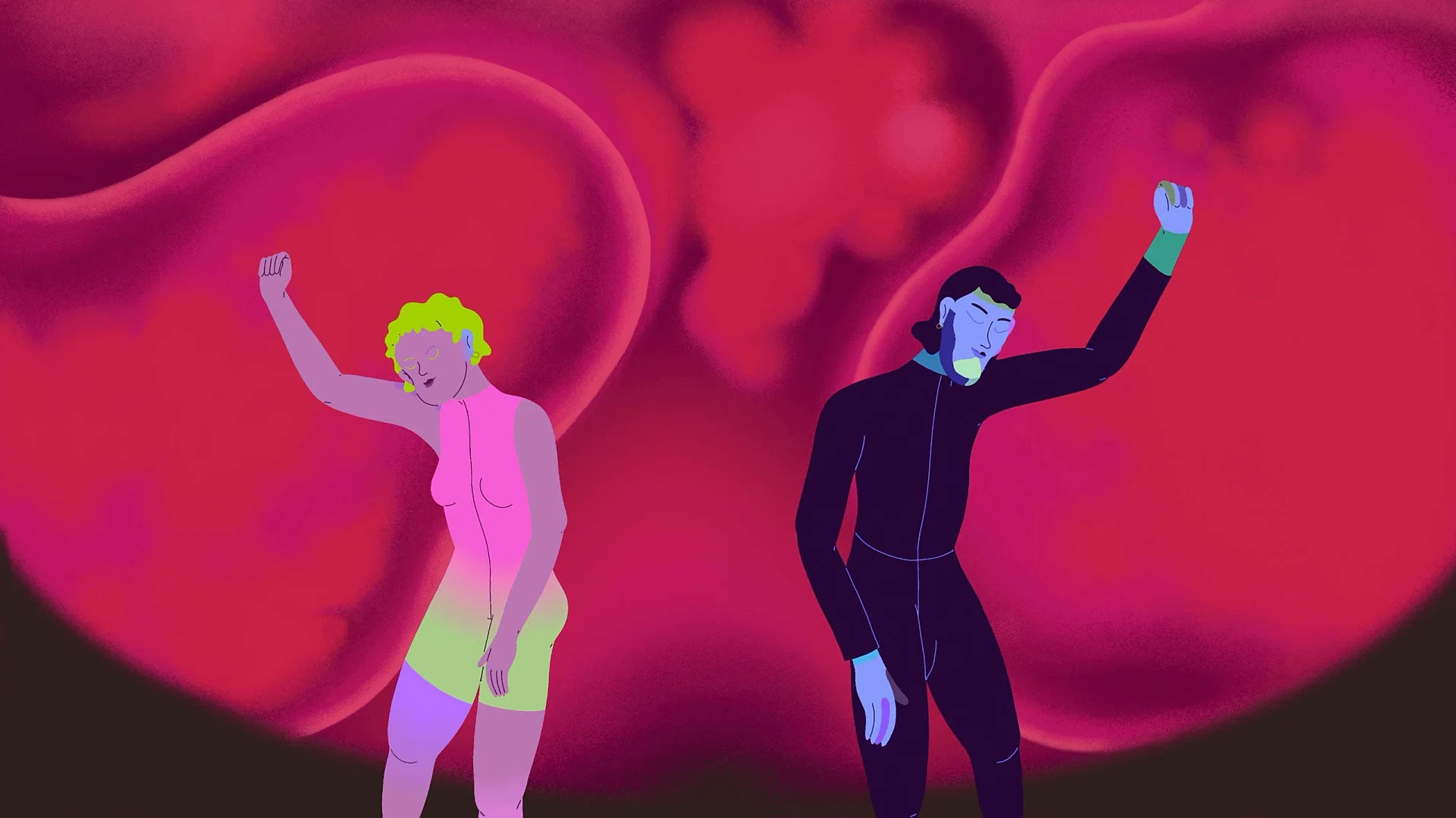
The Electric Kiss (director and writer, Rainer Kohlberg, 2024, 18 min) also uses rapidly changing sights and sounds. It begins with a seemingly human form. According to Kohlberger’s website, the figure is a man in a VR device who is plugged into a “neuro-network that connects the whole of human consciousness,” and who is undergoing a mysterious procedure to relieve the harmful mental effects of this new technology.
The film continues with an ever-changing collection of images. Some are generated algorithmically to produce “visual noise,” brilliantly colored wave-like forms; others are from old sci-fi films. The sound track is variously rhythmically repetitive, eerie, or at an unpleasant pitch. There are subtitles too. Some seem to offer clues to the thrust of the film such as “Now feelings are no longer the best algorithms in the world;” others are cryptic, such as “The average human body contains somewhere between 8 and 50 ghosts;” the final one is, “The future is already set, only the past can be changed, and if it was worth forgetting, it is not worth remembering.”
Producing visual noise qualifies as metamorphosis but I couldn’t find an overall theme in the film related to metamorphosis, unless it’s the entire film itself. Its constant changes in imagery and sound show what immersion in technologically-produced media can do to the senses and the mind, especially when I ran the film at up to for four times normal speed on my computer. That’s a human metamorphosis we should all be taking very seriously.
The Electric Kiss (director and writer, Rainer Kohlberg, 2024, 18 min)
About the author
Sidney Perkowitz is the Charles Howard Candler Professor of Physics Emeritus at Emory University, and an award-winning science writer who writes often about science in film. His latest book is Science Sketches: The Universe From Different Angles.