When the dolphins heard the people laugh, they sang. When the people heard the dolphins laugh, they screamed.
Late last year, while photographing a film in Cape Cod, Massachusetts, I noticed a solitary dolphin slowly making its way across a shallow bay. Having never seen one in real life, I was enamoured, but also intrigued: dolphins move in pods - why was this one alone? As it turned out, dolphin and porpoise strandings in Cape Code and the surrounding waters are fairly common: just last year, the International Fund for Animal Welfare (IFAW) reported around 150 dolphins were stranded in the bay, of which only 80 survived. The IFAW has reported a 2.5x increase in stranded dolphins on a yearly basis - one of several domino effects put into motion by climate change. As New England's coastal waters have grown warmer over the last near-decade, the bait fish that marine mammals feed on have changed their path, moving areas around the Cape. Dolphins and porpoises follow, but their sense of direction gets muddled up in these shallow waters, they get lost, separated from their pods and eventually beached on various sand-banks. Albeit a domino effect, humans are the cause for this disruption.
While the solitary dolphin ingrained itself in my mind, I was captivated by the city of Provincetown: considered a queer haven during, and through the years that followed the AIDS epidemic, there was something beautiful and endearing about being in a city that I could only dream of, having grown up closeted in a relatively conservative Mumbai, India. But despite its colourful past and friendly present, I felt a forlorn sense of decay while walking through Commercial Street in PTown. The bars had faded, paint cracked and peeling on most of the colourful houses. An older gentleman offered me a drink: his husband had passed away in the 80s, he was grieving - a story not uncommon through most of the city's aging queer community, Grindr itself being testament to a constant hunger for companionship amongst the demographic.
Meanwhile, my phone kept buzzing through the weekend: my 80-year-old aunt in Mumbai was cloying for a call. A spinster who recently lost her eyesight, she longs for long-winded conversations each evening, to fill the silence around her after she was abandoned by her two brothers. My sister (who has also left India), and I take turns to mitigate the distance and vacuum she feels, through near-daily calls to her.
What is it about loneliness that is so ubiquitous? Yet, as a species we evolve not only to catalyse it among ourselves, but dictate it to the beings around us?
I asked myself, if sentient beings had a chance to land on Earth today, would they? And if so, why - when on a daily basis, we continue to stomp and tread on a whole universe of other sentient beings that live among us: inter and intra-species. The "lesser beings" - those we cannot understand - which we've chosen to dominate over as a collective human species - from avian to reptilian to mammalian, if they're not "human", we seldom contemplate the effects our "human" actions have on them. Similarly, within our species, we "choose" not to understand, drawing lines of differentiation façaded through socio-economics, but in reality constructed through a century wide social construct: caste. Caste is insidious and therefore powerful because it is not hatred, nor personal. It's worn through grooves of comforting routines and unthinking expectations, patterns of social order that have been in place for so long that it looks like the natural order of things (Wilkerson).
Conflated, we are a selfish set of animals. But we're also confused - eager to be seen, desperate to survive, hungry to be recognized, and starkly afraid of being alone. Why then, can't we live in unity beyond ourselves?
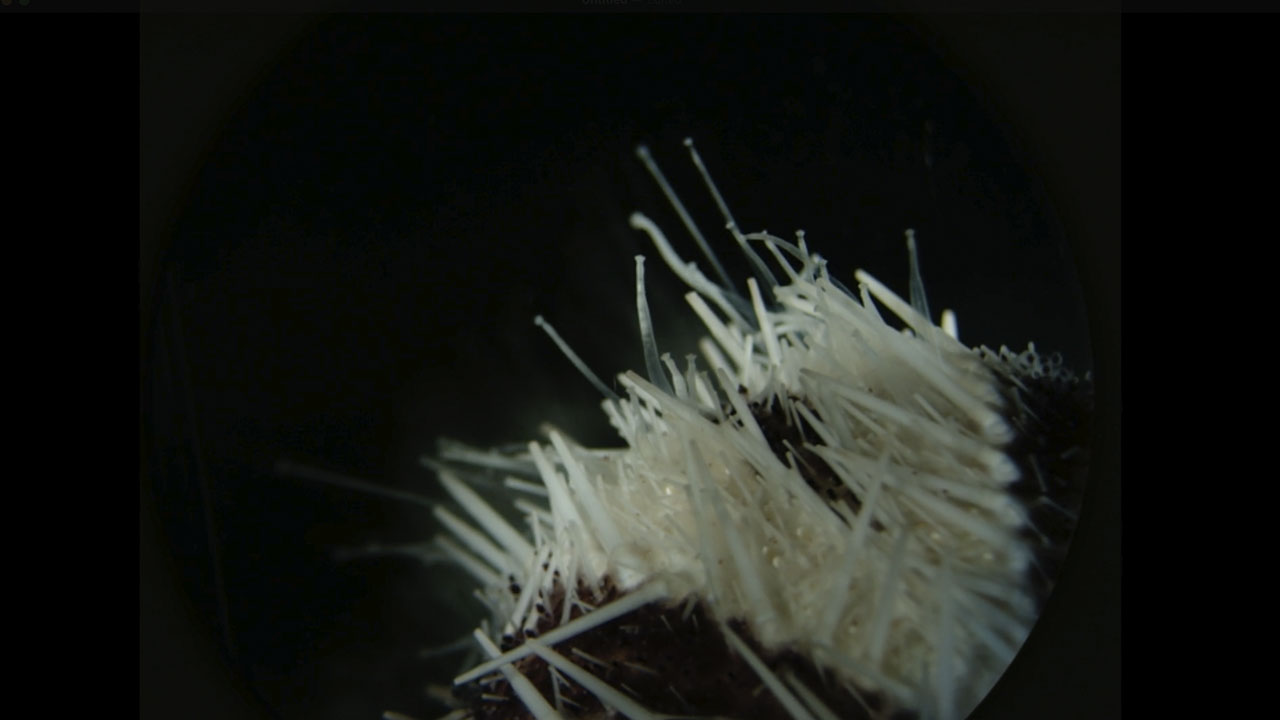
"When the dolphins heard the people laugh, they sang. When the people heard the dolphins laugh, they screamed", draws from these notions and inspirations, and is a three channel projection piece made using High Contrast 16mm film processed with kale juice, hermit crab corpses and seaweed, against an arrested soundscape. Through this piece, I explore the idea of "parallel dimensionality", investigating what curiosity might look like, when non-human sentient beings watch us - boxed out, in our human zoo. The entire piece is synced with a rendition of "Gift Planet", from Brenda Shaughnessy's "The Octopus Museum" - a collection of feminist poems that imagine what comes after our current age of environmental destruction, racism, sexism, intercut with Tenyson's The Lotos Eaters. Shaugnessy's poetry is brought to life through a reading, semi-synchronized by my mother (Reina Gidwani), and I - punctuating the distance between us, and highlighting the very real pain and fears of emigrating amidst today's divisive politics.
Drawing from the notion of a "human zoo", over winter 2024, using a mix of High Contrast film and Tri-X, I photographed various timelapses of human beings going about their day to day business in an everyday tin-box: the Boston MBTA line. The footage was entirely processed using non-toxic eco-developed (comprising kale juice and hydrogen peroxide), and contact printed with decaying hermit crabs from Cape Cod. The resulting footage showcases an interesting mix of "zombified" humans: stuck on their phones, with minimal social interaction. I have continued photographing similar subjects since January 2025, and aim to finish "principal photography" by April 2025. The footage contains optically printed with repeat-text, caught from AI-synthesised "translations" of dolphin, whale and plant sounds. Shaughnessy's poetry.
Credits
Writer
Tushar Gidwani, Brenda Shaughnessy
Producer
Tushar Gidwani, Karen McKeen