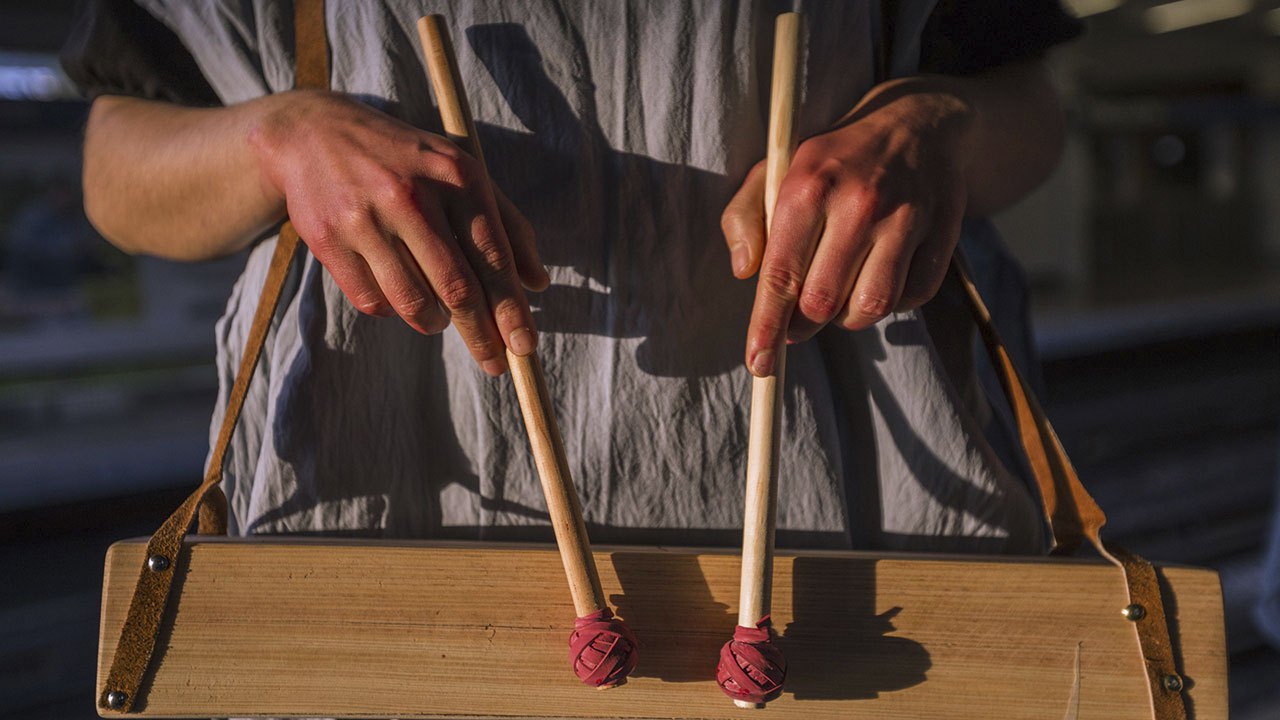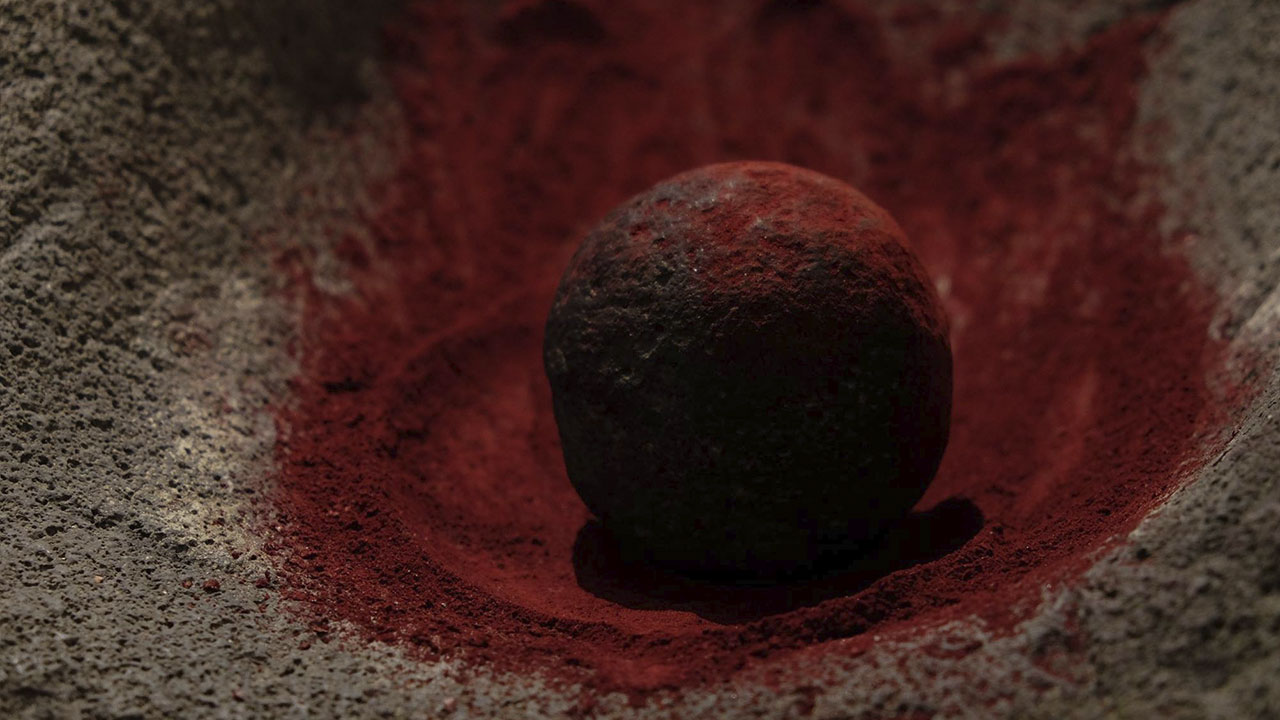

Working across film, sound, and material research, Tania Candiani approaches cinema the way a chemist or artisan approaches matter: patiently, experimentally, with attention to how substances transform. Her films rarely treat color as a surface effect. Instead, pigment is a protagonist—something cultivated, crushed, dissolved, handled, and transmitted across bodies and histories. What we see on screen is inseparable from the gestures that produce it. Hands grind, mix, row, repair; labor leaves traces. Process becomes narrative.
In Campo Carmín (Carmine Field), red emerges from land and organism at once, tying color to agriculture, extraction, and colonial trade. Pigment here is ecological and political—a living archive that binds soil, insects, and human work into a single chromatic field. La Molienda (The Grinding) continues this logic through rhythm and abrasion: the act of crushing becomes both sound and image, turning the making of color into percussion, a collective pulse. The films remind us that every hue has weight and cost; it carries time, touch, and memory.
Still from Campo Carmín (Carmine Field) by Tania Candiani
Still from La Molienda by Tania Candiani
With La Restauradora (The Restorer), Candiani shifts toward care and preservation, foregrounding the quiet intelligence of conservation. Mixing trays, powders, and brushes become cinematic landscapes. Restoration is treated not as repair alone but as a conversation between past and present—a slow negotiation with fragile surfaces. Color here is temporal: it fades, is rebuilt, and lives through attentive hands.
In Pulso (Pulse) , this material thinking expands from the bench to the street. Red no longer sits in a bowl or on a surface—it travels through bodies. Hundreds of women move through the metro beating drums, their synchronized rhythms transforming the city into an instrument. The pulse becomes chromatic: a vibration that stains space through repetition and presence. Sound behaves like dye, saturating air the way carmine saturates cloth. If earlier works show pigment being ground or mixed, Pulso shows color as circulation—blood, breath, tempo—collective and alive. The image is less about hue than about resonance, yet the sensation is unmistakably red: urgent, bodily, shared. Even Remar el Azul (Rowing the Blue) extend this thinking outward, transforming bodily repetition—breathing, rowing, beating—into a kind of chromatic choreography, where movement itself feels like a dye bath that stains space.
Still from La Restauradora (The Restorer) by Tania Candiani
Still from Pulso (Pulse) by Tania Candiani
This sensibility aligns deeply with the Science New Wave ethos. Candiani’s films operate like field studies—part experiment, part poem, part social inquiry—where knowledge is generated through doing. Studio becomes laboratory; craft becomes research; pigment becomes data. Rather than illustrating ideas, the work lets materials speak and lets processes unfold in real time. The result is a cinema grounded in matter and memory, where color is not decoration but evidence: of labor, of history, of the invisible forces that bind bodies to place.